What to Do If You Can’t Pay Your Taxes on Time.
Author: David F. Gremillion, J.D. LL.M. (Taxation)
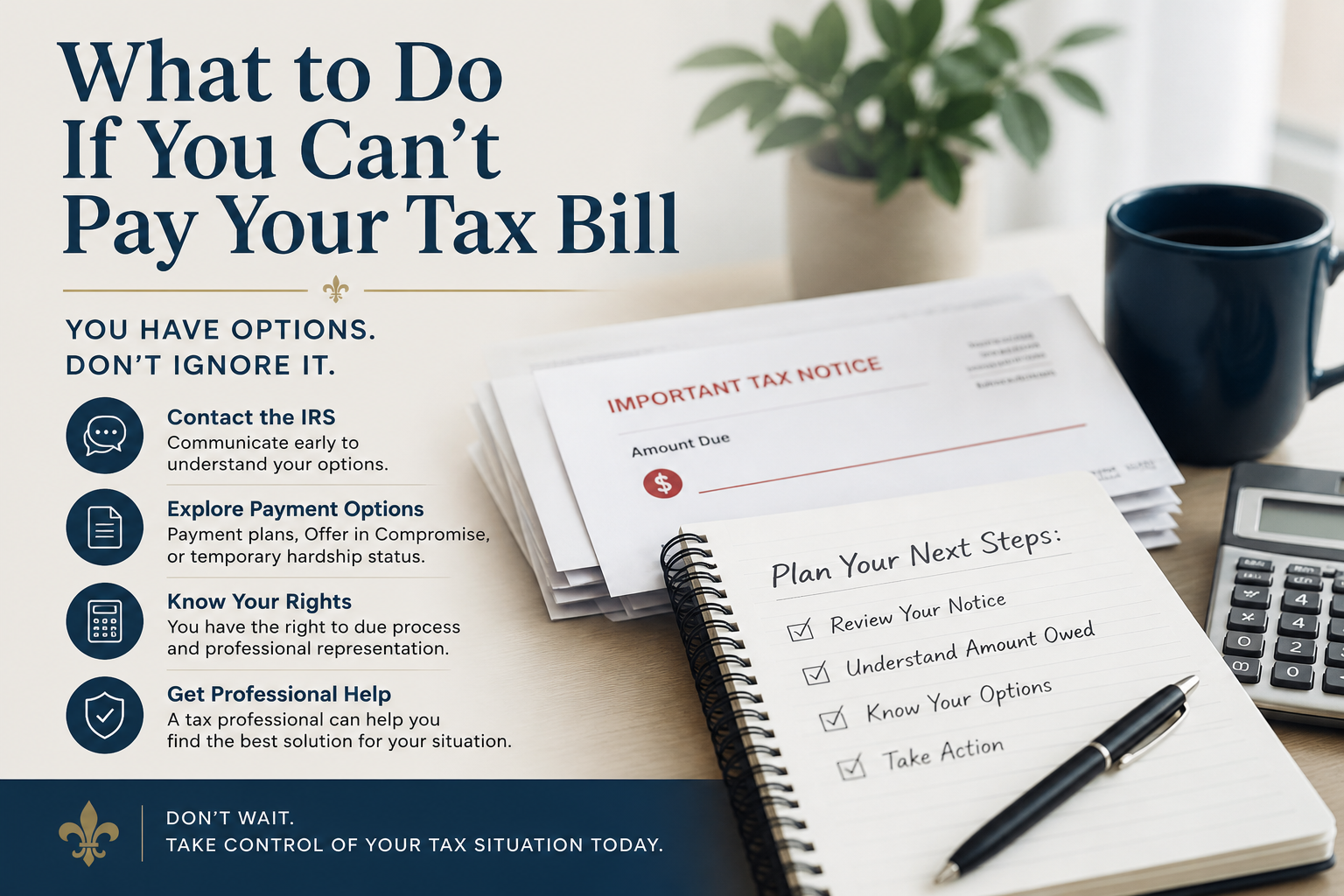
Getting a tax bill, you cannot afford is stressful, especially when the payment deadline is approaching. However, if you can’t pay in full by the due date, do not ignore the problem. The IRS offers several options that may help you manage the balance over time or, in some circumstances, settle the debt for less than the full amount owed.
The most important thing is to act promptly. Filing your tax return on time, paying as much as you can, and exploring your available payment options may help limit additional costs and keep the situation from becoming more difficult.
Filing your tax return on time
If you owe taxes but do not have enough money to pay the full balance, you should generally still file your return by the deadline.
The IRS assesses separate penalties for failing to file and failing to pay. The failure-to-file penalty can be substantially higher than the failure-to-pay penalty. Skipping your return because you cannot afford the tax bill can make the situation worse.
Pay what you can
If you have money available, consider making a payment even if you cannot pay the entire balance.
A partial payment reduces the unpaid balance on which interest and certain penalties may continue to accrue. The IRS generally advises taxpayers who cannot pay in full to pay as much as they can and then consider a payment plan.
However, do not put yourself in an unsafe financial position simply to make a tax payment. Make sure you can still cover necessities such as housing, food, utilities, transportation and other essential expenses.
Consider an IRS payment plan
If you cannot pay your tax bill immediately, an IRS payment plan may allow you to pay the balance over time. Depending on the amount you owe and your circumstances, you may qualify for either a short-term or long-term payment plan.
A payment plan does not make the tax bill disappear. Interest and applicable penalties may continue to accrue while you pay the balance. Before selecting a monthly payment amount, review your budget carefully. A payment plan that appears manageable at first is not helpful if you cannot maintain the payments.
What if you cannot afford any payment?
Some taxpayers face a more serious financial hardship and genuinely cannot afford to make payments.
In those circumstances, the IRS may be able to temporarily delay collection activity. This is not forgiveness of the debt. Penalties and interest may continue to accrue while the collection is delayed, and the IRS may review your financial situation again later.
Offer in Compromise
An Offer in Compromise (OIC) allows a qualifying taxpayer to settle a tax liability for less than the full amount owed. The IRS considers factors including income, expenses, assets, and ability to pay when evaluating an offer.
You must generally be up to date on your required tax filings to be considered for an OIC. You should also be prepared to provide detailed information about your financial situation.
An OIC is not an automatic way to reduce a tax bill. If the IRS determines that you can pay the full amount, either immediately or through a payment plan- you generally will not qualify for an OIC.
Do not forget penalties and interest
One of the biggest mistakes taxpayers make is assuming their tax bill will remain the same until they can afford to pay it.
Generally, the IRS charges interest on unpaid tax starting from the payment due date, and interest continues to accrue until the balance is paid in full. Interest is generally required by law and is not commonly abated.
Late-payment penalties may also increase the amount you ultimately owe. Addressing the balance sooner rather than later may help reduce the total cost.
Penalty relief
In some situations, the IRS may remove or reduce certain penalties.
Taxpayers may qualify for penalty relief if they can demonstrate reasonable cause and show that they exercised ordinary business care and prudence but were nevertheless unable to file or pay on time. The IRS may also offer administrative penalty relief to eligible taxpayers with a qualifying compliance history.
Because eligibility requirements and IRS administrative practices can change, taxpayers should review current IRS guidance or consult a qualified tax professional before relying on a particular form of penalty relief.
The IRS introduced a new Automatic Exemption from Penalty process in 2026 that is replacing the long-standing First Time Abate administrative relief for eligible taxpayers with qualifying compliance histories
Key takeaways
If you can’t pay your taxes on time, do not panic and ignore the bill!
· File your tax return on time, even if you cannot pay the full amount due.
· Pay as much as you can without jeopardizing essential living expenses.
· Review whether an IRS short-term or long-term payment plan is appropriate.
· If you are experiencing significant financial hardship, explore whether the IRS may temporarily delay collection activity.
· Seek penalty relief if you may qualify.
· If eligible, consider applying for an Offer in Compromise.
· Consult a qualified tax professional if the balance is substantial or you have received IRS collection notices.
The best option depends on the amount you owe, your income, your assets, your expenses, and your overall financial circumstances.
Tax rules can be complicated and may change over time. If you would like to discuss your tax situation, contact Jeffords Anthony PLLC to schedule a consultation.
This article is for general educational purposes and is not tax, legal, or financial advice.