SCOTUS Strikes Down Louisiana's Congressional Map: What Louisiana v. Callais Means
Written by: David F. Gremillion, Partner (Mandeville, LA Office)
Make it stand out
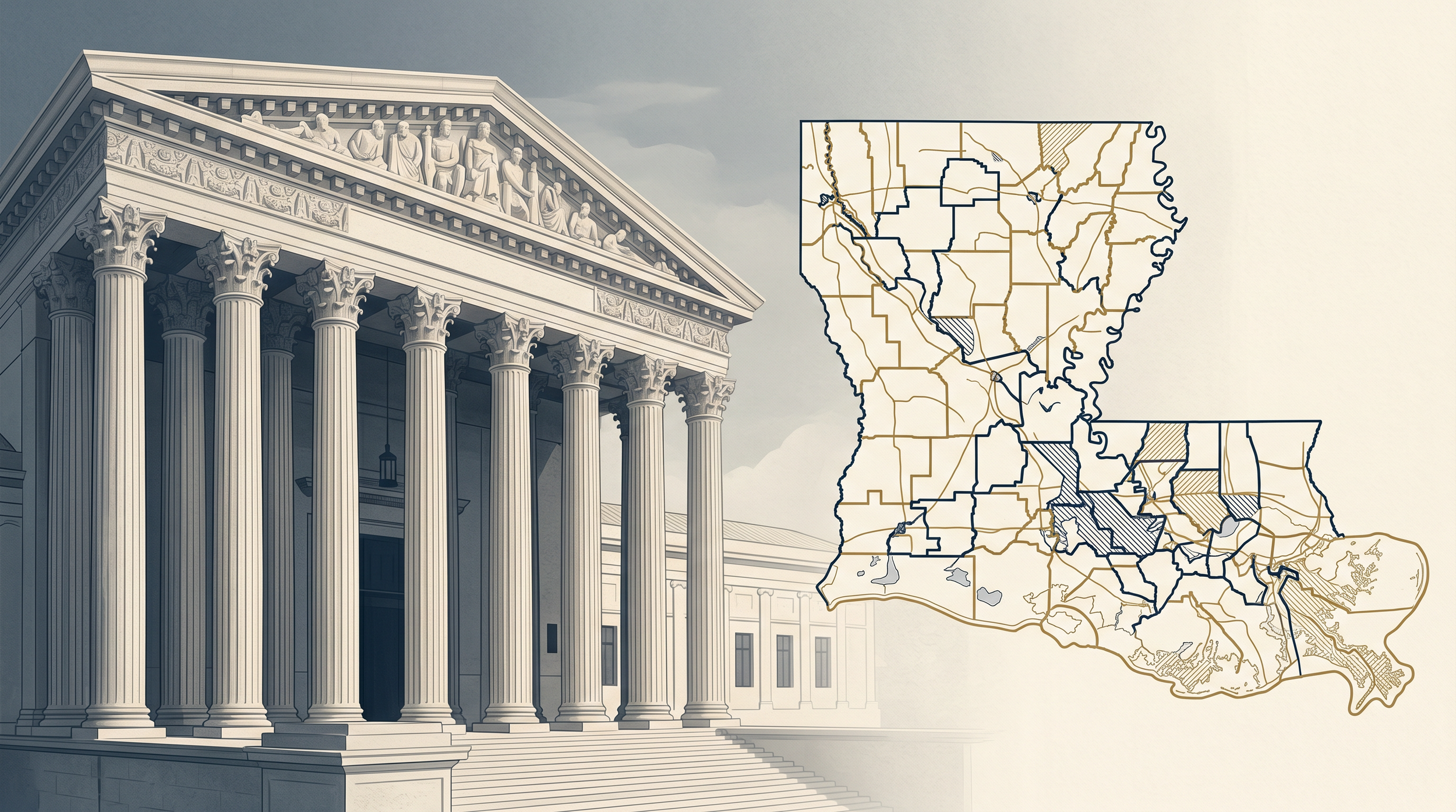
This morning the U.S. Supreme Court handed down its decision in Louisiana v. Callais, ruling 6–3 that Louisiana's current congressional map is unconstitutional. Justice Alito wrote for the majority. Justice Kagan dissented, joined by Justices Sotomayor and Jackson.
What Happened
After the 2020 census, Louisiana drew a congressional map with one majority African- American district. A federal court said that violated the Voting Rights Act and ordered a redraw. The legislature responded with SB8, which added a second majority African-American district stretching from Shreveport to Baton Rouge. A different group of voters then sued, arguing the new map relied too heavily on race.
The Supreme Court agreed. The Court held that Louisiana had no constitutional justification for drawing district lines based on race, and struck the map down.
What the Court Actually Said
The Court did not strike down Section 2 of the Voting Rights Act — the part of the law that protects against racially discriminatory maps. But it significantly tightened how Section 2 cases work going forward. From now on, anyone challenging a map under Section 2 must:
· Draw their proposed alternative map without using race as a factor.
· Show the alternative map meets all of the state's goals — including political ones like protecting incumbents.
· Prove that voting patterns split along racial lines for reasons beyond simple party affiliation (more on this below).
Older evidence about historical or societal discrimination now carries much less weight. The focus is on present-day intentional discrimination.
Justice Kagan, in dissent, warned the ruling renders Section 2 "all but a dead letter."
The Race-vs-Party Problem (and Why It Matters)
The third bullet above is doing most of the heavy lifting in this opinion, so it's worth slowing down on.
In Louisiana — and across the South generally — African American voters overwhelmingly vote Democratic, and white voters overwhelmingly vote Republican. The same election numbers can tell two very different stories:
· Story 1 (race): White voters wouldn't vote for the African American candidate.
· Story 2 (party): White voters wouldn't vote for the Democratic candidate.
Under the old rules, plaintiffs didn't have to pick. If the numbers showed African American and white voters consistently supporting different candidates, that was enough.
Callais changes that. Now plaintiffs have to do the math to separate race from party — essentially proving that white voters wouldn't have voted Republican anyway. That typically requires a political scientist or statistician running a regression that controls for party registration, partisan history, and candidate affiliation, and showing a racial split that remains after you account for partisanship.
Why is that hard? Because in places where race and party are tightly correlated, statistically untangling them is genuinely difficult. Many cases that would have succeeded under the old framework will now fail at this step, not because race isn't a factor, but because plaintiffs can't prove it separately from party.
What This Means for Louisiana
Our congressional map is going back to the drawing board. Expect redraw during the current section or during aa special legislative session so there is a new map before 2026 midterms. This likely means there will be a return to a single majority African American district configuration.
What This Means for Allen v. Milligan
Just three years ago, in Allen v. Milligan (2023), the Supreme Court upheld a Section 2 challenge to Alabama's congressional map and ordered the creation of an additional majority-Black district. Milligan was widely seen as a surprising win for voting-rights plaintiffs and the legal foundation for similar redraws across the South.
Callais doesn't formally overrule Milligan, but it dramatically narrows it. The majority distinguished Milligan on the ground that it didn't directly address the constitutional questions decided today. In practical terms, the new evidentiary requirements, race-blind illustrative maps, controlling for partisanship, present-day-only discrimination evidence — make it much harder to prove the kind of Section 2 violation that Milligan recognized. Maps redrawn in reliance on Milligan, including Alabama's, are now potentially exposed to new challenges.
What This Means Beyond Louisiana
This is the most consequential voting-rights decision since Shelby County v. Holder in 2013. Several states — Alabama, Georgia, Mississippi, South Carolina, Texas — have congressional maps that were reshaped under Milligan and the broader Section 2 framework Louisiana used. Those maps are now vulnerable to new challenges or legislative redraws. The political map of the American South may look different by 2028, and possibly sooner.
Bottom Line
Section 2 is still on the books. But the path to winning a Section 2 case just got considerably narrower. Whether that makes Section 2 a "dead letter," as the dissent predicts, or simply a more demanding statute, will depend on how lower courts apply the new framework.