What Happens if You Die Without a Will in Louisiana?
Author: David F. Gremillion, J.D. LL.M. (Taxation)
Many people assume that, if they die without a will, their spouse or children will automatically inherit everything. In Louisiana, the result is often more complicated
When someone dies without a valid will, Louisiana law treats the person as having died intestate. Instead of a will determining who receives the property, Louisiana’s intestate-succession rules control. Those rules depend heavily on the family members who survive the deceased and on whether property is classified as community or separate property.
For Northshore families in Mandeville, Covington, Madisonville, Lacombe, Slidell, and throughout St. Tammany Parish, understanding those rules can be an important first step toward avoiding uncertainty in a future succession.
Who inherits when there is no will?
Louisiana law provides an order of inheritance when a person dies without a will. The outcome depends on the deceased person’s surviving spouse, children or other descendants, parents, siblings, and other relatives.
A key issue is whether an asset is community property or separate property.
Community property generally includes property acquired during marriage. Separate property can include property owned before marriage, certain inheritances and gifts, and property that otherwise qualifies as separate under Louisiana law. Proper classification is not always simple—particularly for a home, business interest, investment account, or property acquired with mixed funds.
Community property and the surviving spouse.
A common misconception is that a surviving spouse automatically inherits all property when the other spouse dies. That is not necessarily the result in Louisiana.
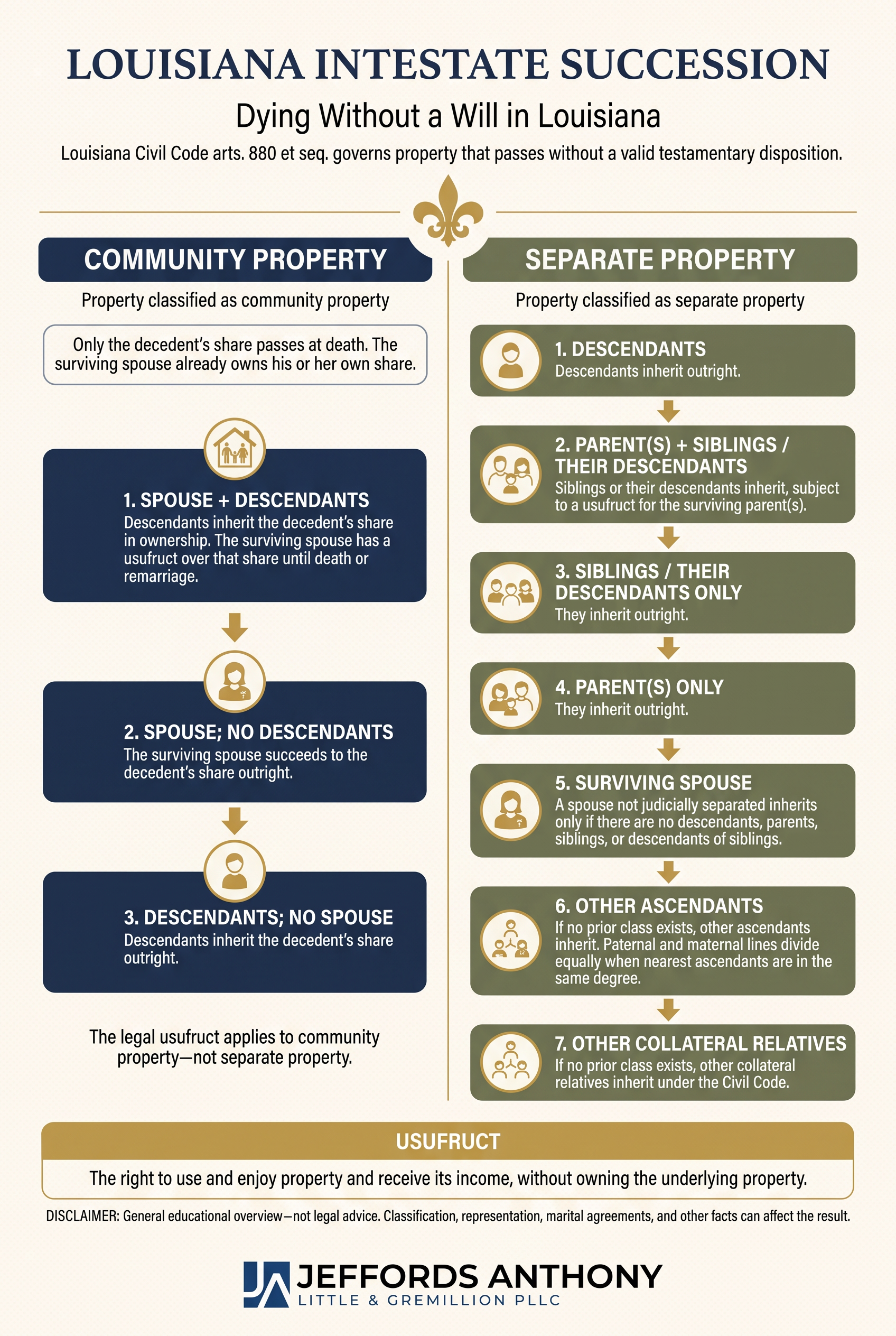
The surviving spouse retains his or her own one-half interest in community property. If the deceased spouse is survived by descendants, the descendants inherit the deceased spouse’s one-half interest in the community property, while the surviving spouse generally has a usufruct over that inherited interest. In practical terms, a usufruct can give the surviving spouse the right to use and enjoy the property, but it is not the same as owning it outright.
Unless changed by a valid testament, the surviving spouse’s legal usufruct over the deceased spouse’s community-property interest generally ends when the surviving spouse dies or remarries.
If the deceased spouse leaves no descendants, the surviving spouse inherits the deceased spouse’s share of community property. The result can be very different depending on the family structure and the assets involved.
What happens to separate property?
Separate property follows different rules.
If the deceased person is survived by children or other descendants, those descendants generally inherit the separate property. A surviving spouse does not automatically inherit the deceased spouse’s separate property merely because the couple was married.
If there are no descendants, Louisiana law looks further into the family tree. Depending on the circumstances, separate property may pass to siblings, parents, or more remote relatives. A surviving spouse may inherit separate property only when the deceased leaves no descendants, parents, siblings, or descendants of siblings.
This can create an outcome that surprises families. For example, a surviving spouse may have rights in community property but may not inherit a deceased spouse’s separate property when the deceased is survived by descendants.
The succession still must be handled.
Dying without a will does not avoid a Louisiana succession. Assets and debts must still be identified, heirs determined, and property transferred. Depending on the circumstances, this may require a judicial succession or may be handled through a statutory affidavit procedure for a qualifying small succession.
Without a will, there also may be uncertainty or disagreement about who should serve as the succession representative and how the estate should be administered. A will can nominate an executor and provide direction for the person responsible for handling the estate. In some situations, a broader estate plan may also help families reduce administrative burdens and provide a clearer path for managing property after death.
What about minor children?
For parents of minor children, estate planning involves more than deciding who inherits property.
In Louisiana, the legal term for a guardian is generally a tutor. Upon the death of either parent, tutorship of a minor child belongs by right to the surviving parent.
The court retains an important role, and the proposed tutor must be able and willing to serve. Still, expressing that choice in a properly prepared will can give the court and your family meaningful guidance at a difficult time.
Do Louisiana’s default rules match your wishes?
The primary issue with dying without a will is not simply that Louisiana has a plan. It is that the plan may not be your plan.
Louisiana’s intestate-succession rules may work reasonably well for some families. But they may not reflect the needs of a blended family, a surviving spouse, a child from a prior relationship, a closely held business, real estate, or property that you want to keep in the family.
A properly prepared estate plan can help you decide who receives your property, who handles your succession, and how your family should be protected. For individuals and families on the Northshore, estate planning is an opportunity to provide clear instructions before loved ones are left to navigate Louisiana’s default rules during an already difficult time.
If you would like to discuss a Louisiana will, succession planning, or a broader estate plan, contact Jeffords Anthony PLLC to schedule a consultation.