Did You Pay IRS Penalties During COVID? You May Be Owed a Refund
By: Partner David F. Gremillion, J.D. LL.M. (Taxation)
What the Courts Held
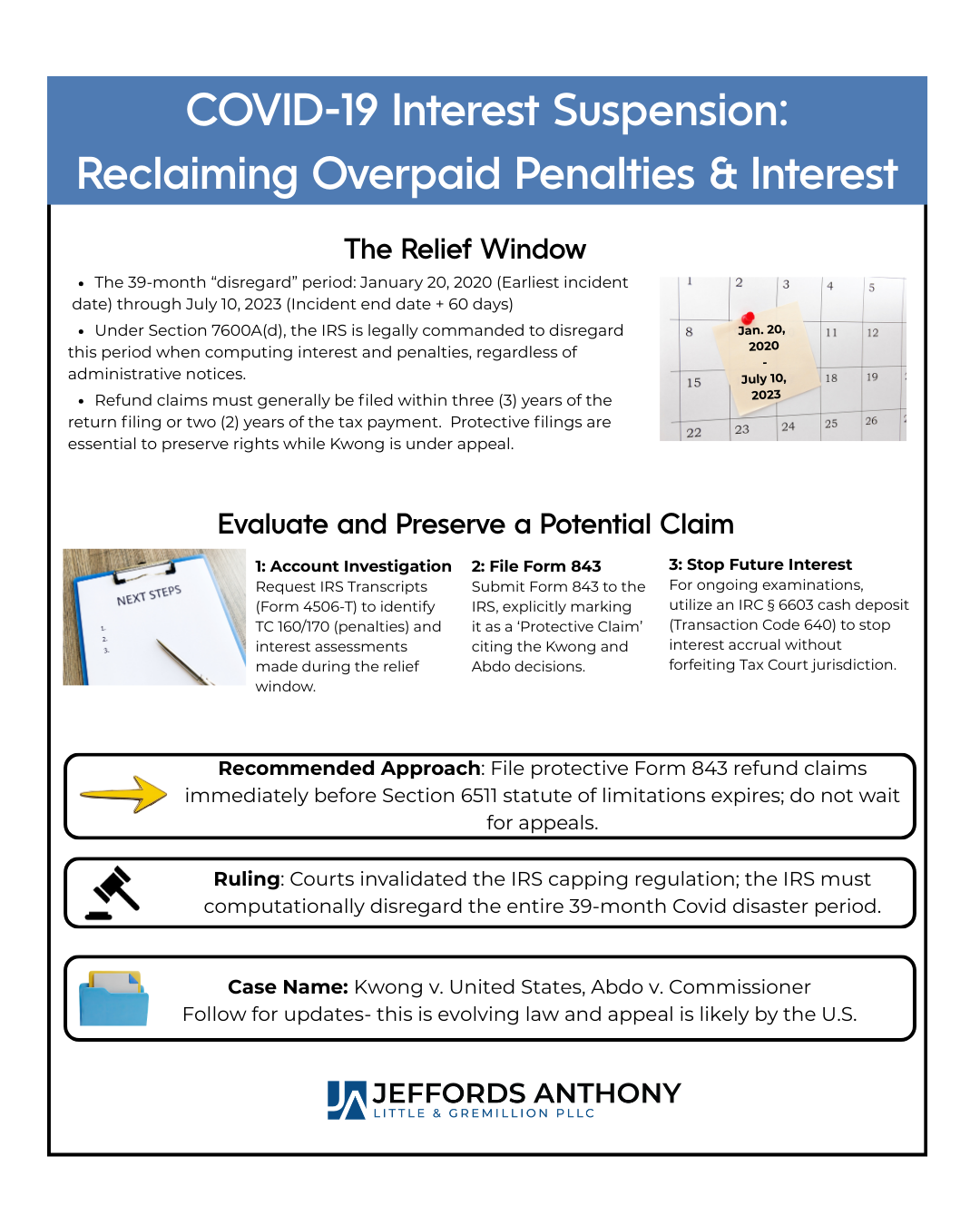
In Kwong v. United States, 179 Fed. Cl. 382 (2025), the U.S. Court of Federal Claims held that IRC § 7508A(d), as written in 2019, the version in effect during the pandemic, mandated the automatic postponement of applicable federal tax deadlines for the entire COVID-19 federally declared disaster period, plus an additional 60 days. The Court ruled the disaster period is January 20, 2020 through July 10, 2023.
Critically, the Court held that the IRS was required to disregard that entire period when computing underpayment interest, failure-to-file penalties, and failure-to-pay penalties, and that a 2021 Congressional amendment narrowing this relief does not apply retroactively to the COVID-19 disaster. The Court also rejected a Treasury regulation attempting to cap the mandatory period at one year, citing the Supreme Court’s Loper Bright decision.
An earlier Tax Court decision, Abdo v. Commissioner (April 2024), reached a consistent conclusion regarding § 7508A(d) and Tax Court filing deadlines during the pandemic. Abdo is now final, having settled without appeal in late 2024. Kwong, however, is not yet final, and an appeal by the government is widely anticipated.
Who This May Affect
• Taxpayers assessed underpayment interest under IRC § 6601 during the disaster period of January 20, 2020 through July 10, 2023.
• Taxpayers assessed failure-to-file or failure-to-pay penalties under IRC § 6651 during the disaster period of January 20, 2020 through July 10, 2023.
Whether a particular taxpayer has a viable claim depends entirely on their specific account history, the nature and timing of the assessments at issue, and the applicable statute of limitations.
The Statute of Limitations: A Critical Variable
Under IRC § 6511, a taxpayer must file a refund claim by the later of three years from the date the return was filed or two years from the date the tax was paid. This period is strictly construed, and a missed deadline generally forecloses recovery permanently.
There is no single universal deadline that applies to all potential Kwong-related claims. The applicable limitations period is determined by the specific facts of each taxpayer’s situation such as when returns were filed and when payments were made. Some limitations periods may already have expired. Individual analysis is required.
Because the limitations analysis is client-specific and limitations periods are actively running, prompt evaluation is important and protective claims should be filed as soon as possible to protect your rights.
Next Steps: How to Evaluate and Preserve a Potential Claim
For taxpayers and advisors who believe this area may be relevant, the following steps frame the path forward. Each step requires individualized analysis.
Step 1: Pull IRS Account Transcripts
Review Account Transcripts for any client with federal tax activity between January 20, 2020 and July 10, 2023. Look for underpayment interest, failure-to-file penalties, and failure-to-pay penalties.
Step 2: Consider First Time Abatement for Penalties First
Before drafting a written Form 843 claim for penalty abatement, contact the IRS to determine if you qualify for First Time Abatement (FTA). FTA can often be granted administratively over the phone for eligible taxpayers with a clean prior compliance history, and it operates independently of the Kwong analysis. If FTA resolves the penalty, the written Form 843 claim can be focused exclusively on the interest refund, where the Kwong argument is most directly applicable.
Step 3: File Form 843 as a Protective Claim Where Appropriate
Where the § 6511 limitations period is still open and the client has potentially eligible assessments, filing a protective Form 843 preserves the client’s rights while the Kwong appeal plays out. The explanation section of the Form 843 is critical and should: (1) explicitly identify the claim as a protective claim pending the government’s anticipated appeal in Kwong v. United States; (2) cite IRC § 7508A(d) as the legal basis and identify the COVID-19 disaster period (January 20, 2020 through July 10, 2023); and (3) reference Abdo v. Commissioner as consistent supporting authority. Imprecise language in the explanation risks IRS rejection on threshold grounds.
Step 4: Do Not Wait for the Appeal to Resolve
The § 6511 limitations period does not pause while litigation is pending. Appeals take a long time, so a protective claim is paramount to protecting your refund rights.
Need help with a potential refund claim? Contact Jeffords Anthony, PLLC for a confidential consultation.
At Jeffords Anthony, PLLC, our attorneys handle IRS controversy matters, penalty and interest abatement, and federal tax issues for clients across the United States.
DISCLAIMER: This article is for general informational purposes only, does not constitute legal or tax advice, and does not create an attorney-client relationship. The decisions described are subject to appeal. Consult a qualified tax attorney regarding your individual circumstances.